Scaling a production line traditionally implies a proportional increase in technical debt and operational headaches. For many small and medium-sized enterprises, the transition from small-batch runs to high-volume output is often stalled by the fear of creating a system so complex it becomes brittle. When every new robotic arm or conveyor requires a bespoke integration and a specialized programmer, the cost of growth can quickly outweigh the benefits. The goal for modern production managers is to achieve “linear scaling”-increasing throughput while keeping the underlying system architecture simple and modular.
The Bottleneck of Bespoke Integration
Custom-built automation solutions are often the primary source of hidden complexity. In many facilities, the packaging or assembly area becomes a patchwork of different brands, communication protocols, and proprietary software. This “Frankenstein” approach makes maintenance a nightmare; a single sensor failure can bring the entire line down because the logic governing it is buried in thousands of lines of custom code.
To avoid this, engineers are moving toward hardware-agnostic platforms. By focusing on standardized interfaces, a facility can swap out tools or add new capabilities without rewriting the entire control logic. This shift allows maintenance teams to support multiple stations with a single set of skills, rather than requiring a specialist for every individual machine.
Modular Tooling as a Growth Lever
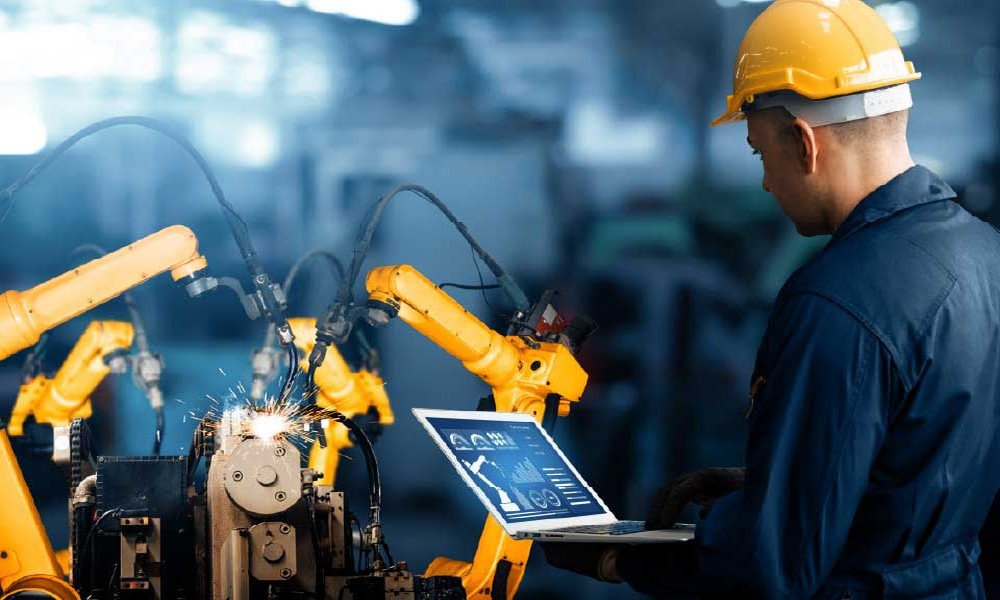
The hardware at the end of a robotic arm is often the most critical factor in system flexibility. If a robot is hard-wired for a single task, scaling requires purchasing entirely new cells for every product variation. Modular end-effectors change this dynamic by allowing a single robot to handle diverse tasks-such as shifting from CNC machine tending to palletizing-within the same shift.
Versatility is the core driver of an efficient floor layout. Utilizing a unified ecosystem like OnRobot products enables integrators to deploy standardized grippers, sensors, and changers across different robot brands. This eliminates the need for multiple different software interfaces and specialized cabling for every new tool added to the fleet. When the interface remains consistent, the complexity of adding a second or third robot remains virtually zero, as the logic used for the first deployment is easily replicated.
Standardizing the Human-Machine Interface
Complexity often peaks during the hand-off between human operators and automated systems. A system that requires a PhD to troubleshoot is not a scalable system. Human-centric design in automation focuses on intuitive interfaces that allow floor staff to reconfigure tasks on the fly.
Reducing “button-to-action” latency ensures that if a production goal changes at noon, the line is adjusted by 12:05. This is achieved through graphical programming environments and hand-guiding features. When the staff on the floor can teach a robot a new path without calling an external integrator, the enterprise gains an immense competitive advantage in agility.
Simplification Through Data Transparency
True scaling requires a clear view of where the system is losing time. However, adding complex monitoring software can often lead to “data fatigue.” Scalable systems prioritize a few key performance indicators (KPIs) over a flood of raw data.
By focusing on cycle times and error rates at the tool level, managers can identify bottlenecks before they cause a stoppage. A simplified data loop ensures that as the number of machines grows, the effort required to monitor them does not grow at the same rate. Growth should be about adding capacity, not adding layers of management. Focusing on interoperability and standardized hardware allows a facility to expand its footprint while keeping its operational logic lean and manageable.